Commission Reviews Sweeping Zoning Code Rewrite
Simsbury's Planning and Zoning Commission reviewed a roughly 50 percent draft of a complete zoning rewrite, with no votes taken.
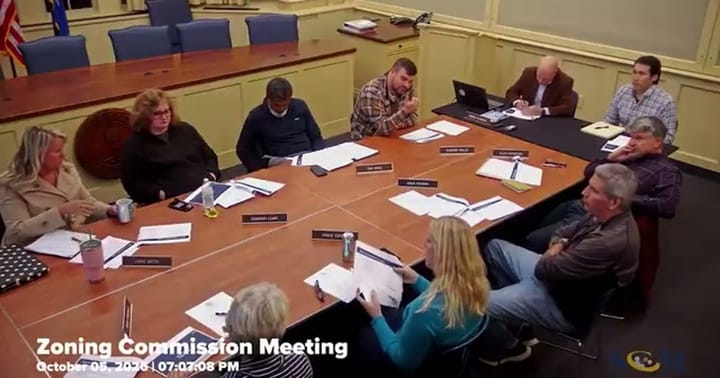
Planning and Zoning · Meeting of October 5, 2026
Simsbury's Planning and Zoning Commission reviewed a roughly 50 percent draft of a complete zoning rewrite, with no votes taken. Consultant Francisco Gomes said the document, covering sections 1 through 17, section 20, section 29 and 31, is actually closer to two-thirds complete and will bring Simsbury into compliance with Public Act 25-1's requirement to allow two-to-nine-unit "middle housing" on commercial lots and with the 2015 Reed v. Town of Gilbert ruling requiring content-neutral sign regulations.
Draft changes would drop restaurants' special exception requirement in business zones to a simpler site plan review, prompting one commissioner to ask, "So when the public comes out against it, how are you, what are you going to say?" The rewrite also eliminates the unused Housing Opportunity Development zone covering the town-owned, 323-acre Meadowbrook property, with no replacement designation yet chosen, and proposes new solar energy, floodplain and sign-permit standards. Gomes estimated public hearings could begin by February or March 2027.
In the full story:
- Who Was There
- Organizations And Documents Referenced
- The complete report — 3,301 words
Source: the Planning and Zoning meeting of October 5, 2026, reported from the official video recording and transcript.
Checked against the record: before publication this article was automatically compared with the meeting transcript. It was corrected where it differed.
The Full Article
The 50 Percent Status Report
Simsbury's Planning and Zoning Commission has been working with consultant Francisco Gomes, of the firm identified in the meeting as IMAG, on a comprehensive rewrite of the town's zoning regulations for several months. The October 5 session was billed as a "50 percent" status update, though Gomes told the commission the actual completion level is closer to two-thirds of the document. The question before the commission was not a vote but a working review: staff and the consultant wanted direction on open policy choices before finalizing draft language ahead of eventual public hearings.
Gomes said the current draft is available in the commission's Dropbox and on the town planning department's website, with the most recent version dated September 28. He said the rewrite touches sections 1 through 17, 20, 29 and 31 of the regulations and is intended to correct what he described as deficiencies in the existing, decades-old code: zones that appear on the town's zoning map but have no corresponding text, standards that rely on commission discretion the courts have found impermissible, and permit requirements that are inconsistently documented.
Legacy Zones: Apartment, Design Multiple Residence, Village Cluster and HOD
Background and stakes: Simsbury's zoning map includes an "apartment zone" and a "design multiple residence district" that have appeared on the map since before 1984 but have no active text regulations, because the 1984 rewrite removed the language without updating the map. Staff must currently consult the 1984 regulations when a property owner in one of those zones seeks even a minor permit, such as a shed addition.
The question before the body: whether to restore minimal standards for these legacy zones, remove unused floating zones entirely, and decide what to do with the Housing Opportunity Development (HOD) zone, which covers the town-owned, roughly 323-acre Meadowbrook property.
Substantive content: Gomes said the draft adds back the "minimum" standards needed to regulate the apartment and design multiple residence zones as they exist today, while prohibiting any new land from being rezoned into those categories. The village cluster zone, a floating zone that was "never actually been landed" on the map, is being removed outright. The single-family cluster zone, which has been mapped and used, is retained in simplified form. The HOD zone — created specifically to allow a 390-unit affordable housing project at Meadowbrook that officials agreed will never be built — is being eliminated from the regulations, but commissioners and Gomes agreed they have not yet settled on a replacement zoning designation for the property, including a roughly 20-to-25-acre sub-parcel. One member raised the option of an agricultural or public-property designation if the commission wants to preserve the land from development; no decision was made.
The deliberation: A commissioner asked whether the smaller, previously undeveloped parcel within the HOD area could be treated differently. Gomes said "they're all the same. It's all HOD," meaning any new zoning designation chosen would need to cover the full 323 acres, including the smaller tract, unless the commission specifically carves out a distinct zone for it.
Procedural steps and outcome: No motion was made. Staff and Gomes will return with zoning map and designation options for Meadowbrook.
Implications and what is next: The HOD zone's removal forces a separate decision about Meadowbrook's future zoning designation before the broader regulation package can be finalized and mapped.
Simsbury Center Zone and Hartford-Simsbury Form-Based Code Cross-References
This was a brief, largely technical item. The draft adds a new section explicitly stating that the Simsbury Center Zone and the Hartford-Simsbury form-based code remain separate documents but are formally part of the town's zoning regulations, with their own standards controlling in the event of a conflict. A commissioner asked whether the final document would hyperlink to those separate regulations; Gomes said that was technically feasible but had not yet been built into the draft.
"Character" Standards, Commission Discretion and the McKenzie Case
Background and stakes: The Connecticut legislature has limited municipalities' ability to deny applications based on vague "neighborhood character" language, and a Connecticut court case Gomes referred to as the "McKenzie" case found that zoning commissions, unlike zoning boards of appeal, lack authority to vary their own regulations on a case-by-case basis.
The question before the body: whether to continue granting itself open-ended discretion (for example, authority to increase commercial lot coverage from 40 percent up to 60 percent without written criteria) or to replace that discretion with fixed, objective standards.
Substantive content: Gomes said the draft replaces "character"-based language with measurable standards such as density and setback requirements. On lot coverage specifically, he said the commission's current regulations allow it to increase commercial coverage limits by up to 50 percent above a 40 percent base — reaching 60 percent — without specifying what an applicant must demonstrate to qualify. The evolving recommendation discussed Monday was to eliminate the variable standard altogether and simply raise the flat coverage limit, with the number "most recently" landing near 50 percent, according to Gomes, though commissioners did not finalize a figure.
The deliberation: A commissioner questioned who is actually setting these numbers. "But when you say we, you with staff," the commissioner said, prompting Gomes to clarify that staff drafts proposed numbers for the commission's review and revision. Gomes framed the simpler path as a policy trade-off: "If we think 40 percent is too restrictive, let's go with something a little less restrictive that still controls this," rather than retaining a discretionary variance the commission cannot legally exercise the way it currently claims to.
Procedural steps and outcome: No vote. The commission did not settle on a final coverage percentage; Gomes said staff will continue drafting fixed standards and return for further commission input.
Implications and what is next: Any final numeric standard adopted will set a hard ceiling on commercial lot coverage town-wide, replacing the commission's current, legally questionable discretionary authority.
Floodplain, Outdoor Dining and Alcohol-Use Regulations
Background and stakes: The Connecticut State Building Office adopted the 2015 International Residential Code in 2018, which imposes stricter flood-hazard construction standards than Simsbury's current zoning text reflects. Separately, Public Act 21-29, a COVID-era law, permanently requires towns to allow outdoor dining without special permits.
Substantive content: Gomes said the draft floodplain regulations are modeled on the Connecticut Department of Energy and Environmental Protection's template for inland riverine communities (as opposed to coastal communities), customized for Simsbury, where flood-hazard areas are concentrated along the Farmington River. The changes affect new construction and "substantial improvement" projects — work exceeding half a home's replacement value — primarily by requiring equipment and living space to be elevated one to two feet above the base flood elevation, rather than the current, looser "above" standard. He stressed the changes do not alter FEMA flood maps or boundaries, only construction requirements. For outdoor dining, the draft removes any suggestion that a special exception or site plan is required, aligning with Public Act 21-29. The alcohol-use regulations were simplified to require a special exception for any tavern, bar or package store regardless of the specific state liquor-permit classification, removing redundant cross-references to state permit types.
Procedural steps and outcome: No vote; both sections are drafted and under staff review.
Implications and what is next: Property owners doing substantial flood-zone renovations will face materially stricter elevation requirements once adopted; no restaurant or alcohol-use permitting burden changes for existing businesses.
Solar Energy, Sustainability and a Possible Prohibited-Use List
Background and stakes: Simsbury's regulations currently reference an undefined "alternative energy system" use with no actual standards, which Gomes said created uncertainty, illustrated by a dispute over a church's rooftop solar installation that exceeded an unwritten limit.
The question before the body: whether to adopt specific solar energy standards, consider an impervious-coverage limit in residential zones, and whether to create a formal town-wide prohibited-use list, an idea first raised at a prior meeting.
Substantive content: The draft adds separate standards for building-mounted and ground-mounted solar for both residential and commercial properties, with limits based primarily on height and accessory-use square footage; rooftop solar is treated as largely unregulated beyond building code. Gomes said the commission is still weighing whether to add a residential lot-coverage (impervious surface) limit for stormwater and urban-heat reasons, noting solar panels would be exempted from any such coverage calculation because the ground beneath them still drains. On prohibited uses, Gomes said Simsbury's regulations already function as an effective "everything not permitted is prohibited" system, but a specific list would let the commission formally bar uses such as data centers if desired. One commissioner said constituents have raised concerns about data centers; a prior conversation with someone described as "Stephen Antonio" was cited as suggesting such a use is unlikely to be proposed, but the commissioner said it remains "very much in the news."
Procedural steps and outcome: No vote. Staff will present options for addressing data centers and other possible prohibited uses; the residential coverage-limit question remains open pending further analysis.
Implications and what is next: Any eventual residential coverage cap or formal prohibited-use list would be new regulatory territory for Simsbury and would likely be among the more closely watched provisions once a hearing draft is released.
Business and Industrial Use Table Changes
Background and stakes: The current use table has gaps and inconsistencies — some uses in active operation in town, such as dry cleaners, were never specifically named or regulated.
The question before the body: whether to accept staff's proposed, color-coded changes to permitted and special-exception uses across business (B) and industrial (I) zones.
Substantive content: Using a color-coded table, Gomes walked through specific changes: animal daycare becomes a newly defined, separately regulated use (distinct from a kennel, with no overnight stays), allowed by special exception in the B2, B3 and I zones; dry cleaners require a special exception in all business and industrial zones; gas stations move from a site-plan use to a special exception requirement town-wide and become newly allowed in I zones; "government library" is renamed "government facility" and broadened to cover community centers and police stations, with its permit requirement reduced from special exception to site plan in B zones because, Gomes said, municipal buildings do not warrant the added burden; restaurants in B zones move from special exception to site plan, removing the public hearing requirement; and three similar senior-living use categories (assisted living, congregate/senior housing, and continuing care retirement communities) are consolidated into a single "senior care community" use with no change in where or how they are permitted.
The deliberation: The restaurant change drew the most direct pushback. One commissioner asked what happens if a new restaurant proposal draws neighborhood opposition under the new, hearing-free site-plan process: "So when the public comes out against it, how are you, what are you going to say?" Gomes responded that staff considers public hearings for restaurants an unnecessary cost burden on small businesses given high restaurant failure rates, comparing the hearing requirement to "an excise tax that you're placing on a new business." A separate exchange addressed private clubs and places of worship: Gomes explained that under the federal Religious Land Use Protection Act (as referenced in the discussion), the town cannot impose a stricter permit requirement on a congregation than on a similar private social club, so the draft raises the private-club requirement to special exception rather than lowering the religious-use standard.
Procedural steps and outcome: No vote taken; the use-table changes remain in draft form for continued commission review.
Implications and what is next: If adopted as drafted, new or converted restaurants, dry cleaners, gas stations, animal daycares and several other business types would face different permitting paths than they do today, with restaurants in particular losing the current public hearing requirement.
Middle Housing: Public Act 25-1 Compliance
Background and stakes: Public Act 25-1, a Connecticut law taking effect July 1, 2026, requires municipalities to allow "transit community middle housing" — defined as two-to-nine-unit residential buildings or mixed-use buildings of the same scale — on any commercially or mixed-use zoned lot, subject only to a streamlined "summary review" process, with no special exception or public hearing allowed except on narrow public health and safety grounds.
The question before the body: how Simsbury's draft regulations should implement this state mandate without exceeding or falling short of what the statute requires.
Substantive content: Gomes read the statutory language directly to the commission and explained the draft creates a new "middle housing" use category encompassing two types: "middle housing residential" (a straight multifamily building of two to nine units, which could technically include a "cottage cluster" form the state specifies, though Gomes called that form "highly unlikely" to be built in Simsbury) and "mixed-use middle housing" (the same unit range combined with a non-residential use in the same building, with the commercial component capped so it does not exceed the residential component). Both would be permitted in B zones under a site-plan approval process, which Gomes said satisfies the statute's "summary review" requirement without creating a new application type. The draft requires compliance with all standard zone dimensional requirements (coverage, setback, height) plus a minimum amount of usable outdoor space per unit, and preserves the statute's sole carve-out: an application can be denied or modified if a development would be "substantially impactful to public health and safety," which Gomes said is a high legal bar, offering a fire-suppression-access scenario as a hypothetical example.
Procedural steps and outcome: No vote; the draft language is considered substantially complete pending final commission review. Gomes summarized the net effect succinctly: "We've got to allow two to nine units in our B [zones]. It's that simple."
Implications and what is next: Once adopted, property owners in Simsbury's business zones will be able to propose two-to-nine-unit residential or mixed-use buildings without a special exception or public hearing, a significant procedural shift from the town's historic approach to multifamily housing review.
Sign Regulations: Content-Neutral Compliance
Background and stakes: In Reed v. Town of Gilbert (2015), the U.S. Supreme Court ruled that municipal sign regulations cannot be based on a sign's message or content, only on its "time, place and manner" — size, height, location, lighting and duration. Gomes said most Connecticut communities, including Simsbury, have not updated their sign codes since that ruling and remain legally vulnerable.
The question before the body: whether the proposed reorganization of sign types and standards achieves content-neutral compliance while preserving the town's practical control over signage.
Substantive content: Gomes outlined roughly a dozen defined sign types replacing Simsbury's current, overlapping categories, including A-frame signs, bulletin board signs, freestanding signs, incidental signs, projecting signs, five categories of temporary freestanding signs (construction, general use, real estate, new residential development and home improvement), temporary wall/banner signs, wall signs and window signs. He said the draft keeps existing size standards largely intact — no changes to the current 32-square-foot benchmarks, for instance — while adding previously undocumented rules on permitted lighting (introducing "halo lighting" as a newly defined category) and clarifying which signs require a permit. Under the draft, A-frame signs, incidental signs, window signs, and general-purpose, home-improvement and real-estate temporary freestanding signs would be allowed "as of right" with no permit required; new residential development signs and temporary wall/banner signs would require a temporary sign permit; and bulletin board, freestanding, projecting and wall signs would require a standard sign permit. Gomes said similar content-neutral codes he has drafted are in place in Stonington, Manchester, Bristol and Glastonbury.
The deliberation: A commissioner, referred to in the discussion as Tony, raised concerns about A-frame signs being left out overnight, calling it "literally the biggest complaint" the town receives, and asked whether a nightly removal requirement could be enforced. Gomes said that issue is addressed in the temporary-sign permit section rather than the as-of-right A-frame category and proposed the commission revisit the specific time restriction once it reviews that section in detail. A separate exchange clarified the limits of content-neutrality: a commissioner initially understood that a "grand opening" banner sign could not be regulated based on its message, prompting Gomes to clarify that the town can still permit a "new business or change of ownership" banner sign by use-trigger, just not by requiring specific wording such as "grand opening." Gomes also flagged that the sign rewrite, unless commissioners direct otherwise, will not automatically extend to the separately governed Simsbury Center Zone: "If we come up with an acceptable sign regulation, we should just apply it everywhere... [otherwise] Center zone is not fixed."
Procedural steps and outcome: No vote. Gomes said the sign section requires a dedicated future session, given its complexity, and recommended a possible community information meeting before any hearing draft is finalized.
Implications and what is next: Businesses using A-frame signs, banners and other temporary signage face a materially different permit and enforcement structure once adopted; the commission has not yet decided whether the new content-neutral sign rules will extend to the Simsbury Center Zone.
Schedule
Gomes told the commission the full regulatory rewrite should be substantially drafted by the end of 2026, followed by a commission comment period, legal and internal staff review, and possibly a topic-specific community session (likely focused on signs). He estimated public hearings could realistically begin in February or March 2027, contingent on continued progress.
WHO WAS THERE
Commission chair, addressed in the meeting only as "Mr. Chair" — no name given in the transcript, agenda or minutes supplied.
A commission member identified in discussion as Tony — surname not given.
Other unnamed commission members participated in the discussion; individual identities could not be reliably attributed from the transcript audio.
Zoning Enforcement Officer, identified in the meeting only as George — surname not given. Described as having worked extensively with the consultant on the draft.
Francisco Gomes, consultant with the firm identified in the transcript as IMAG, presented the status report.
No roster, agenda or minutes document was supplied for this meeting, so full attendance and membership could not be independently verified.
ORGANIZATIONS AND DOCUMENTS REFERENCED
IMAG — the consulting firm, represented by Francisco Gomes, retained by the town to draft the zoning regulation rewrite.
Connecticut Department of Energy and Environmental Protection (DEEP) — publishes model floodplain regulations used as a template for Simsbury's draft flood-hazard section.
Connecticut State Building Office — adopted the 2015 International Residential Code in 2018, driving the need for updated floodplain construction standards.
Public Act 21-29 — Connecticut's COVID-era law requiring municipalities to allow outdoor dining without special permits; also cited regarding limits on "character"-based denials.
Public Act 25-1 — Connecticut law effective July 1, 2026, requiring towns to allow two-to-nine-unit "middle housing" in commercial/mixed-use zones under summary review, and eliminating residential parking minimums for developments of 16 or fewer units.
Connecticut General Statutes Section 8-2 — the statute establishing municipal zoning authority, cited regarding the Public Act 25-1 compliance requirement.
Reed v. Town of Gilbert (2015) — U.S. Supreme Court ruling cited as the basis for the content-neutral sign regulation rewrite.
McKenzie case (town name unclear in transcript) — Connecticut court case cited as establishing that zoning commissions, unlike zoning boards of appeal, lack authority to vary their own regulations.
Religious Land Use Protection Act (as referenced in discussion) — federal law cited as requiring parity in permit requirements between places of worship and private clubs.
Lights Out Connecticut — source of the "dark sky" model lighting regulations underlying the town's proposed lighting section.
Sustainability Committee — town committee that previously submitted sustainability-related recommendations referenced regarding solar and coverage standards, not yet incorporated into the draft.
Towns of Stonington, Manchester, Glastonbury and City of Bristol — cited by the consultant as having adopted similar content-neutral sign regulations he drafted.
Meadowbrook property — the roughly 323-acre, town-owned parcel currently zoned Housing Opportunity Development (HOD), discussed as needing a new zoning designation.
Share this story
Know someone in Simsbury who follows town government? Share Townbrief Simsbury: they can sign up free.