Zoning Board OKs Signs, FEMA Rule; Car Wash Waits
Simsbury's Planning and Zoning Commission approved two park sign permits and a FEMA floodplain text amendment but continued a contested car wash hearing to October 19.
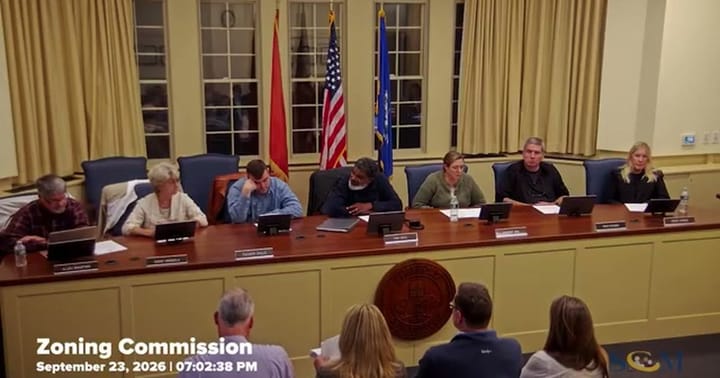
Planning and Zoning · Meeting of September 23, 2026
Simsbury's Planning and Zoning Commission approved two park sign permits and a FEMA floodplain text amendment but continued a contested car wash hearing to October 19. The commission voted 6-0 to approve signs for Oracle Field and Simsbury Farms, and 6-0 to adopt floodplain regulation updates tied to FEMA's remap, effective November 13, 2026. The bulk of the meeting centered on a proposed car wash at 10 Dorset Crossing, where attorney Dwight Merriam represented the applicant and attorney Jane Warren represented intervener Thomas Sermon, who argued the facility sits atop a protected aquifer.
Engineers disagreed over water-use estimates, with one figure dropping from 32,000 gallons a day to 10,600 after design refinements. Commissioners said "the people we've heard from don't even agree on the definition of wastewater" and postponed a decision until October 19.
In the full story:
- Who Was There
- Organizations And Documents Referenced
- The complete report — 2,396 words
Source: the Planning and Zoning meeting of September 23, 2026, reported from the official video recording and transcript.
Checked against the record: before publication this article was automatically compared with the meeting transcript.
The Full Article
Minutes and Routine Business
The commission opened by seating alternate member Alan in place of absent member Jackie, then approved minutes from its September 2, 2026 special meeting and its September 9, 2026 regular meeting. The September 9 minutes were amended on the floor to correctly record a 4-2 vote on a prior application, ZC 26-18, a correction a commissioner identified as George requested before the vote. Both sets of minutes passed without recorded opposition. Neither item generated discussion beyond the correction and carries no further implications for residents.
ZC 26-22: Oracle Field Entrance Sign
Background and stakes: The town has spent roughly four years replacing outdated park signage across Simsbury with a standardized design. Oracle Field, a baseball facility at 75 Old Farms Road used for youth lacrosse and soccer, was never included and has never had an entrance sign.
The question before the body: Whether to grant a special exception under Section 9.6 of the Simsbury Zoning Regulations for a freestanding, 13.4-square-foot sign matching the town's standard green-and-wood design.
Substantive content and deliberation: Parks and Recreation Director Tom, serving as the town's agent, told the commission the sign had already cleared the Design Review Board without added comments or conditions. A commissioner asked whether the sign's placement near Old Farms Road could obstruct sightlines for vehicles exiting the park; staff confirmed the sign is one-sided, parallel to the road, and subject to the town's standard visibility-intersection requirement. No members of the public spoke.
Procedural steps and outcome: The commission closed the public hearing by voice vote, then approved the application 6-0, conditioned on submission of a landscaping plan before a building permit issues, substantial conformance with plans stamped received by the planning department on August 10, 2026, and staff authority to approve minor changes.
Implications: The sign can now be installed without further commission review, provided staff signs off on landscaping details.
ZC 26-23: Simsbury Farms LED Message Sign
Background and stakes: Simsbury Farms, a 108/100 Old Farms Road recreation complex drawing more than 100,000 visitors a year across its golf course, ice rink and tennis facilities, sought an internally illuminated LED message sign to communicate programs, events and closures. Because the town's regulations otherwise prohibit internal illumination for signage, the applicant first obtained a variance from the Zoning Board of Appeals.
The question before the body: Whether the proposed sign's site plan, now carrying a prior ZBA variance, met Section 9.6 special-exception standards, and what conditions should attach.
Substantive content: Assistant Town Planner Brittany McGilton told the commission the sign is not visible from any public road and would operate only during facility hours, which vary seasonally from dawn to dusk or later during the ice rink season. The Design Review Board recommended rotating the stone cladding on the sign's support columns 90 degrees to a horizontal orientation and substituting a wood facade, or a recessed wood design, for the stone. Staff said current dark-sky regulations do not apply to signage. Asked whether the sign would carry paid advertising, the director said no, though the facility may acknowledge business partnerships.
The deliberation: One commissioner voiced concern about precedent, noting the sign functions almost like it sits on private property even though it is technically on town land and worried similar LED boards could proliferate townwide, including near Simsbury High School. Town Planner George responded that any precedent was already set when the Zoning Board of Appeals granted the illumination variance on a case-by-case basis with its own required findings, and noted the town's regulations already permit variable message boards, unused so far, in the center zone.
"Will you approve a recreating precedent?" a commissioner asked; staff replied that "the zoning board of appeals approves everything on a case-by-case basis," citing the eight to ten findings the ZBA must make for each variance.
Procedural steps and outcome: The commission closed the hearing and approved the application 6-0 with six conditions, including a minimum 10-second static display requirement, power-off outside facility hours, a required landscaping plan, conformance with the plans stamped received August 10, 2026, staff authority over minor changes, and conformance with the Design Review Board's recommendations.
Implications: The sign may proceed to construction once staff confirms design conformance; the precedent question raised by one commissioner remains unresolved as a matter of future policy rather than this specific approval.
ZC 26-24: FEMA Floodplain Text Amendment
Background and stakes: FEMA began restudying Simsbury's flood zones in 2018 and delivered preliminary remapping to the town in 2023, triggering a required notice period to affected property owners. The new maps take effect November 13, 2026. As part of the federal flood insurance program, the state Department of Energy and Environmental Protection reviews local floodplain regulations for compliance with federal standards, prompting this text amendment.
The question before the body: Whether to amend Sections 6 and 17 of the zoning regulations to update referenced map dates, revise definitions, and add a floodplain variance provision the town previously lacked.
Substantive content: Staff described the changes, highlighted in yellow in the packet, as largely technical: updated map-date references, revised definitions, and a new variance mechanism for floodplain cases. Staff noted additional floodplain regulation changes are expected as part of a broader zoning rewrite now underway.
Procedural steps and outcome: The commission closed the hearing and approved the amendment 6-0. The approval motion was amended on the floor, on a friendly amendment, to correct a staff-report reference date from September 28, 2026 to September 23, 2026, and specified the amendment becomes effective once state publishing requirements are met.
Implications: The amendment keeps Simsbury's floodplain regulations compliant with the National Flood Insurance Program ahead of the November 13 effective date for the new FEMA maps, which could affect insurance and building requirements for property owners in revised flood zones.
ZC 26-19: Dorset Crossing Car Wash Site Plan Review
Background and stakes: The commission previously approved a car wash as a permitted use for 10 Dorset Crossing, Lot F, through a PAD amendment, and separately granted a nearby resident, Thomas Sermon, intervener status under the state's environmental protection act. That status gives Sermon standing equal to the applicant to argue the project is reasonably likely to unreasonably pollute, impair or destroy the state's air, water or natural resources. Tuesday's hearing addressed only the site plan, not the underlying use approval.
The question before the body: Whether the proposed roughly 7,275-square-foot car wash's site plan conforms to zoning and site-plan regulations, and separately, whether the intervener met the burden of showing a reasonable likelihood of unreasonable environmental harm sufficient to trigger a feasible-and-prudent-alternatives analysis.
Substantive content: Town Planner George outlined the legal standard: the intervener must offer substantial evidence, not mere speculation, that the project is reasonably likely to cause unreasonable harm; if the commission finds such harm, the burden shifts to the applicant to show no feasible and prudent alternative exists. Engineer Brandon Hanfield described site plan revisions since the original submission: the canopy shrank from 750 to 552 square feet to satisfy a fire marshal requirement for a 20-foot unobstructed bypass lane; two self-serve-bay catch basins were consolidated into a single deep-sump catch basin with a trap hood; and the water utility, Aquarion, committed to serve the project at an average 10,600 gallons a day and a peak of 21,200, contingent on a reclamation system recovering up to 65 percent of water used. A commissioner pressed Hanfield on an earlier 32,000-gallon-a-day estimate he had given roughly a month prior; Hanfield said that figure came from unadjusted meter readings at an existing facility with growth and safety factors applied, while the 10,600-gallon figure reflects per-car, per-nozzle calculations from the wastewater system design.
Attorney Dwight Merriam, representing the applicant, argued the car wash is an approved use outside the commission's aquifer protection jurisdiction, that carryout rinse water is not "wastewater" under the regulations, and that no Connecticut car wash in an aquifer protection area has ever been shown to have contaminated groundwater. He offered to accept conditions barring outdoor vehicle activity beyond vacuuming and requiring alarms on floor drains. He also challenged intervener exhibits as lacking legal foundation, including photographs from the applicant's Colchester facility and a consultant report he said failed to include a required Section 8-1e disclosure.
Attorney Jane Warren, representing intervener Thomas Sermon, countered that the zoning definition of an exempt "car wash facility" requires both continuous attendance during operating hours and "complete recycling of all washwaters," neither of which this unattended, partially self-serve facility provides. She argued aquifer protection regulations treat a car wash as regulated unless all, not most, wastewater is lawfully discharged to the public sewer, and that even minor, undetectable releases of PFAS, regulated by EPA only since 2024, could impair a sensitive aquifer.
"We cannot sample their carryout water... that is not going to give us what is in this carryout wastewater."
— Jane Warren, attorney for the intervener
Licensed environmental professional Adam Henry of GZA/GCA Geoenvironmental testified that car washes generally are not watertight and that any uncaptured wash water flowing to the site's catch basins and detention basin would eventually reach groundwater. Pressed on whether the specific design showed a flaw, Henry said: "there's nothing that I can point to and say this is a bad design," but maintained the aquifer location itself was the concern. Rebuttal witness Plato Dundalakis, testifying for the applicant, said the facility's hazardous materials would be stored in secondary containment and that the business's own manufacturer letters show no PFAS in its proprietary products, while acknowledging testing equipment itself can contain trace PFAS from Teflon components, making an absolute guarantee impossible.
Merriam closed by citing a DEEP Natural Diversity Database response, received two days before the hearing, stating DEEP does "not anticipate negative impacts to any state-listed species resulting from the proposed activities."
Procedural steps and outcome: No vote was taken. Commissioners said they wanted time to review the DEEP letter and to resolve disagreement over the applicable definition of wastewater before deciding whether the intervener met its evidentiary burden. With the applicant's attorney consenting, the commission continued the application to its October 19, 2026 meeting, since an October 5 meeting is already reserved for a separate zoning-regulation rewrite discussion.
Implications and what is next: The October 19 session will determine whether the commission finds the car wash's design poses an unreasonable risk to the aquifer and, if so, whether the applicant can show no feasible and prudent alternative location exists, a threshold that could require redesign, relocation, or approval with added conditions.
Staff Transition
Town Planner George told the commission that Assistant Town Planner Brittany McGilton has accepted a position as town planner in Newington and will leave Simsbury after October 1, 2026. Commissioners thanked McGilton for her work on the sign and site-plan applications reviewed that night.
WHO WAS THERE
Commission members present: Tucker (voted, seconded motions); Kate (seconded a motion); Alan (seated as alternate for member Jackie); a member referred to as Stacey/Stacy (made and seconded motions); a member referred to as Annie (handled draft motion language); additional members participated in discussion without a first name clearly isolated in the transcript. Member Jackie was absent. The commission chair presided but was not named in the transcript or available documents.
Staff: Town Planner George (surname not given in available sources); Assistant Town Planner Brittany McGilton, departing for a town planner position in Newington; a town engineer was referenced by Brandon Hanfield but not named.
Town agent/applicant for sign items: Parks and Recreation Director Tom (surname rendered inconsistently in the transcript as Taberski, Tyburski and Daburski), agent for the Town of Simsbury on ZC 26-22 and ZC 26-23.
Car wash applicant side: Attorney Dwight Merriam, representing the applicant and a contract purchaser/developer of the 10 Dorset Crossing property; Brandon Hanfield, professional engineer, identified with a firm name transcribed as Antic River Consultants; Plato Dundalakis, licensed environmental professional and certified hazardous materials manager, testifying in rebuttal for the applicant.
Intervener side: Attorney Jane Warren of the law firm McCarter and English, representing intervener Thomas Sermon; Adam Henry, licensed environmental professional and geologist with a firm transcribed as both GZA Geoenvironmental and GCA Geoenvironmental, based in Glastonbury, Connecticut; Thomas Sermon and his wife, Alana Sermon, the intervening residents, whose address was transcribed as 111 West Ledford.
Public commenters: One unidentified member of the public asked whether the Simsbury Farms sign would carry paid advertising; staff confirmed it would not.
ORGANIZATIONS AND DOCUMENTS REFERENCED
Design Review Board — reviewed both sign applications and recommended wood-facade and orientation changes for the Simsbury Farms sign, folded into the final approval conditions.
Zoning Board of Appeals — previously granted the illumination variance required for the Simsbury Farms LED sign, cited in the precedent discussion.
FEMA — conducted the flood zone restudy beginning in 2018 that produced the preliminary maps and the resulting text amendment, ZC 26-24.
Connecticut Department of Energy and Environmental Protection (DEEP) — reviewed the town's floodplain regulations for FEMA compliance; also responded to a Natural Diversity Database inquiry on the car wash application, finding no anticipated impact to state-listed species.
Aquarion Water Company (transcribed as "Aquarian"/"Aquarium") — issued the will-serve letter capping the car wash's water use at 10,600 gallons average/21,200 gallons peak daily, contingent on the on-site reclamation system.
Simsbury Water Pollution Control Department / publicly owned treatment works (POTW) — cited repeatedly as the agency with authority over sanitary sewer discharge from the car wash.
Simsbury Conservation Commission — held prior proceedings on the car wash referenced extensively by both attorneys regarding photographs, NDDB review and prior testimony.
McCarter and English — law firm representing intervener Thomas Sermon.
GZA/GCA Geoenvironmental — environmental consulting firm providing Adam Henry's testimony for the intervener.
Simsbury Plan of Conservation and Development — cited by attorney Jane Warren, particularly its natural-resource protection goals, as context for the zoning commission's aquifer protection role.
Connecticut environmental protection act (CEPA) intervention statute — the legal basis for Thomas Sermon's intervener status and the "reasonably likely to unreasonably pollute" evidentiary standard discussed at length.
Simsbury Aquifer Protection Regulations, including the Section 2a35g car wash facility definition and Section 17.4 wastewater definition — the central disputed text throughout the ZC 26-19 deliberation.
Staff report dated September 23, 2026 (corrected from a September 28 reference in the draft motion) — basis for the ZC 26-24 floodplain amendment approval.
Share this story
Know someone in Simsbury who follows town government? Share Townbrief Simsbury: they can sign up free.