Selectmen Adopt Expanded Veterans Tax Exemption
Simsbury Selectmen approved an expanded veterans property tax exemption and sat through nearly two hours of public pushback on Flock license plate cameras.
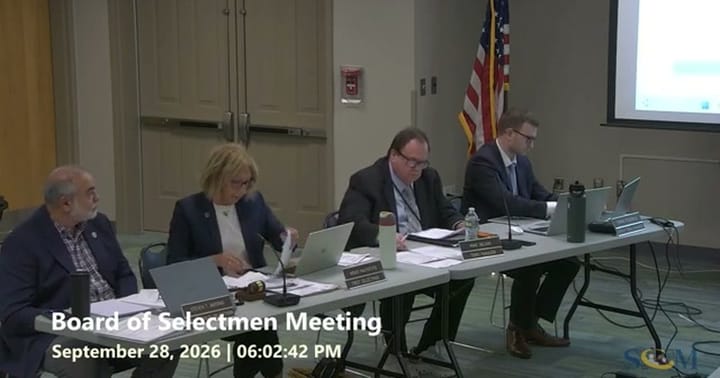
Board of Selectmen · Meeting of September 28, 2026
Simsbury Selectmen approved an expanded veterans property tax exemption and sat through nearly two hours of public pushback on Flock license plate cameras. The board unanimously adopted a TDIU benefit, a two-acre land exemption and a surviving-spouse provision retroactive to January 1, 1970, which the assessor estimated would add about $346,150 to the town's total veterans tax exemptions. More than a dozen residents, including Jill Mooneyham and attorney Melissa Osborne, urged the board to drop its contract with Flock Safety, warning "flock does the same thing automatically for everyone without a warrant." Police Chief Nick Bolter said the cameras had investigative value in nearly 73 percent of 2025 burglary cases and cost $24,950 a year for eight units; no vote was taken on the cameras.
The board also approved, 3-2 and 4-1 on separate items, appropriations for state grants covering a library teen space, the Meadowood apple barn and Eno Memorial Hall.
In the full story:
- Who Was There
- Organizations And Documents Referenced
- The complete report — 3,297 words
Source: the Board of Selectmen meeting of September 28, 2026, reported from the official video recording and transcript.
Checked against the record: before publication this article was automatically compared with the meeting transcript.
The Full Article
Public Comment: Allegation Against Deputy First Selectman
Resident Joan Cole opened public comment with an allegation that Deputy First Selectman Steve Antonio has refused to lift a no-trespass order filed against her with the Simsbury Police Department after she photographed and reported sign-code violations at properties associated with him, including Antonio's Restaurant and the Hideaway Bar. Cole said a town-ordered ADA compliance audit dated September 29, 2025, flagged signage issues at several businesses, including Antonio's, but that Antonio did not file similar no-trespass complaints against the town employees who conducted that inspection. She also argued that Town Manager Mark Nelson and Deputy Town Manager Tom Fitzgerald have been improperly directed by First Selectman Wendy McTusis in violation of the town charter's prohibition on selectmen giving orders to administrative staff. Cole was cut off at the three-minute limit and told the board she would continue her remarks elsewhere. No selectman responded to the allegations on the record, and the item was not on the agenda for board action.
Public Comment: Advocacy for Veterans Tax Exemption Options
Branchbrook Drive resident Eric Frederick, a disabled combat veteran who said he deployed five times to Afghanistan, urged the board to adopt the full package of local options for the state-mandated veterans property tax exemption ahead of the board's later vote on the matter. He told the board the local options would affect about 67 households, those veterans the VA has rated totally disabled or unemployable, and that adopting every option without a value cap would add roughly $19 a year to the median homeowner's bill. He cited Avon's and Southington's adoption of similar two-acre provisions as regional precedent. His remarks framed the debate the board would return to later in the meeting.
Public Hearing: Flock Safety License Plate Readers
Background and stakes: Simsbury installed six stationary Flock license plate reader cameras in 2024 and has budgeted to renew and expand them through fiscal year 2027. A new Connecticut Public Act addressing permissible LPR use, vendor requirements, retention periods and data sharing takes effect October 1, 2026, and the Connecticut Police Officers Standards and Training Council released a statewide best-practices document the week before the meeting. The item was placed on the agenda as a public hearing combined with a staff presentation, not a vote.
The question before the body: whether to continue, expand, pause, or discontinue the town's use of Flock cameras, and what additional oversight residents should expect.
Substantive content and deliberation: More than a dozen residents spoke, almost all opposed to continued use of the cameras. Nurse and software developer Daniel O'Connell focused on who inside Flock can access captured data and whether the company can be independently audited. Tucker Sauls, a Tariffville business owner, invoked the limits of local control over "someone from above the town" misusing the system. Luke Gilmore, speaking from 8 Bradley Road, cited a reported incident in which a hacking group physically stole a Flock camera and discovered it could track identifying features such as height, build and bumper stickers, not just plates. Resident Jill Mooneyham, whose own car had been stolen in Simsbury, said she supported crime-fighting tools in principle but opposed the cameras because of what she called their "slippery slope" design, citing the case of a Florida driver, Lindsay Isaacs, jailed 13 days after a misread plate. Resident Jacqueline Malucci asked what happens to the town's data if Flock goes out of business, citing the FBI's own recent breach and the bankruptcy of the genetic-testing company 23andMe as cautionary examples. Attorney Allen Bradford, who represents health technology clients, asked whether Flock's SOC 2 security certification results are actually shared with the town rather than simply claimed. Renee Bradford asked who manages and audits Simsbury's contract and noted reported misuse cases involving officers in Georgia and New York.
"Has our town ever been notified of a breach? If so, what was our response? How are we going to hold flock accountable to ensure they are doing everything they can to protect our information?" [00:24:38] — Jacqueline Malucci, Simsbury resident
Attorney Melissa Osborne, who described herself as having worked with Police Chief Nick Bolter at the legislature, said she trusts the police department but argued that contractual safeguards are only as strong as a private vendor's willingness to follow them. Resident Lori Boyko argued on constitutional grounds, citing Carpenter v. United States and Marbury v. Madison, that "fundamental rights do not come from this town government" and that automated tracking amounts to a warrantless dragnet.
Chief Bolter responded with a lengthy history of the program. He said Simsbury's stolen-vehicle rate, which historically averaged about five a year, peaked at 32 in 2023 amid a regional wave of street takeovers and organized vehicle theft, prompting the department's original 2023 request for stationary readers. The board approved that request unanimously in October 2023 at a cost of $39,900 for installation and two years of use, and approved dash-camera-integrated readers through a 10-year Axon contract in June 2024. Bolter said a review of 2025 burglary investigations found LPR images had investigative value in nearly 73 percent of cases: they identified a suspect vehicle in 54 percent and served as the key evidence or connecting factor in 27 percent. He described specific cases, including locating a missing Simsbury man's vehicle via out-of-state Flock cameras in Flagstaff, Arizona and Ontario, California, and intercepting a stolen vehicle involved in a gas station burglary. He said images are retained for 30 days, do not include facial recognition, and are not accessible to federal immigration authorities; Simsbury disabled immigration-related search options in 2025. He said the eight cameras planned for fiscal year 2027 cost $24,950 annually.
Board members pressed on oversight. Selectman Mike Payne asked whether the town receives any report on who accesses shared data; Bolter said no formal report exists yet but that a vendor told him providing one is a fourth-quarter goal. A selectman serving as the police commission liaison asked whether Simsbury would still benefit from neighboring towns' camera data if it withdrew from the network; Bolter said sharing is reciprocal and the town likely would not receive outside data if it did not also share its own. First Selectman Wendy McTusis noted the town paused its next planned camera installation at the governor's request and that trust in the vendor, not the police department, remains the unresolved issue.
Procedural steps and outcome: No motion was made and no vote was taken. The Police Commission separately adopted an updated LPR policy at its September 14, 2026 meeting, effective October 1, 2026, incorporating the new state law and moving to monthly internal audits.
Implications and what is next: The October 1 state law cuts data retention from 30 to 21 days and tightens interstate sharing requirements. McTusis indicated the board expects to revisit the topic again as the state's new best-practices document is reviewed.
Semi-Annual Capital Projects Review
Background and stakes: Deputy Town Manager Tom Fitzgerald presented the board's twice-yearly update on capital projects, covering completed work and projects still in design or construction.
Substantive content: Fitzgerald reported the Firetown Road sidewalk and the Simsbury Performing Arts Center punch-list work are essentially complete; the performing arts center project returned about $149,000 in unspent funds. The Station Street, Eno Hall entrance and parking lot improvements are finished. The town hall rooftop unit replacement came in at $256,000 against a $293,000 supplemental appropriation, and a separate $825,000 roof-repair project, funded in this year's capital plan, is just beginning design. Fitzgerald outlined the Curtis Park bike path, estimated at $2.3 million with an 80 percent federal match, which may require a referendum depending on final cost, and the Tariffville Greenway, now fully designed and funded by the Connecticut Department of Transportation at a rough construction value of $12 million, including a new bridge over the Farmington River. He also described an ongoing review of neighborhood paths and connecting trails, asking the board for direction on whether to repave, convert to stone dust, or discontinue several informal pathways, excluding the Stratton Brook trail, which remains hampered by drainage problems tied to an adjacent condominium association and state Department of Energy and Environmental Protection ownership.
The Climax Road Bridge replacement, funded 100 percent through state and federal sources, is now estimated at $4.3 million for full replacement after the design team located original construction plans; a public information meeting is scheduled for November 4 at the library. The Stoddard Dam removal project will lower water levels an additional two feet starting next July, with full removal targeted for 2028 pending a FEMA BRIC grant. A roundabout is proposed for the County Road and Hoskins Road intersection, with a public information meeting planned this fall; board members asked why a stop sign was never considered, and Fitzgerald said a non-standard stop could increase risk given low compliance expectations.
Fitzgerald also flagged a funding gap on the Meadowood historic barn restoration: bids came back at $2.3 million against a $650,000 budget, driven by three decades of roof failure and structural rot. He said the town plans to send a letter to the State Historic Preservation Office, known locally by its grant-program nickname "Shippo," asking for additional funds or a reduced scope, since the town cannot absorb the full cost. Other items included a nearly complete repair of the Community Farm barn, fire alarm system upgrades out for design-firm interviews, an under-budget septic receiving station upgrade at the water pollution control plant, a new aeration-efficiency contract with Weston and Sampson engineers, a $2.2 million high school track and turf replacement with design-build contractor Field Turf targeted for completion by fall 2027, early coordination on a privately funded pavilion project, and a solar power purchase agreement with Green Skies for the high school and Latimer Lane, pending state NRES program approval expected in December.
Implications and what is next: No vote was required for this review. The board will need to decide this fall and winter on referendum questions for the Curtis Park bike path and on how to respond to the Meadowood barn funding shortfall.
Veterans Property Tax Exemption Ordinance
Background and stakes: State law already requires Simsbury to exempt a portion of disabled veterans' home value from taxation; the board has discretion over several local options, including a TDIU benefit, a two-acre land exemption, a surviving-spouse provision and a cap tied to the town's median assessed residential value. The board began deliberating at its September 14 meeting and returned to finish the discussion September 28.
The question before the body: which combination of local options to adopt, and what retroactive date to use for the surviving-spouse benefit.
Substantive content: The assessor's office presented six sample properties showing how each option combination would affect individual tax bills, plus townwide totals. Adopting the TDIU and surviving-spouse benefits alone, without the cap or acreage option, would increase the town's total veterans exemptions by about $306,000 to $346,150 over current law, depending on how the two benefits were combined. Selectman Mike Payne favored basing the exemption solely on each veteran's actual dwelling value, without the median cap or the two-acre addition, arguing that approach was "the fairest way to both the veteran and to the public." Other members, working from the assessor's comparison tables, favored combining the two-acre exemption with the median cap, which the assessor said would direct a proportionally larger benefit to veterans with lower-valued homes.
"I think you unintentionally end up hurting them more because that burden is now shifted there, and the median cap necessarily goes down." [02:25:21] — Member discussion (unattributed in transcript), on the tradeoff between the median cap and property values
On the surviving-spouse date, the board initially discussed 2020 and 1970 as cutoff years, ultimately settling on January 1, 1970, to capture Vietnam-era disabilities, including those linked to Agent Orange exposure that were diagnosed decades after a veteran's death.
"So are we in agreement 1970?" [02:15:13] — Chair, polling the board
Procedural steps and outcome: The board voted, with all members in favor, to amend town code chapter 131, article 6, effective September 28, 2026, adopting the TDIU benefit, the two-acre exemption, the surviving-spouse provision retroactive to January 1, 1970, and the median assessed-value cap. The ordinance takes legal effect 21 days after publication of a summary in a newspaper of general circulation in Simsbury.
Implications and what is next: The expanded exemption applies beginning with the 2026 grand list; it is not retroactive for payment purposes. The assessor's office will finalize the retroactive surviving-spouse date before publication.
Library Teen Space Grant
Background and stakes: A state legislator-directed grant of $350,000, obtained through the office of a state senator, became available for a library teen space renovation that had previously been budgeted in an out-year of the capital plan at $65,000 for design and $350,000 for construction.
The question before the body: whether to apply for, accept, and appropriate the grant funds, given that no final design or cost estimate yet exists.
Substantive content and deliberation: Selectman Curtis pressed on process, noting the board was effectively being asked to commit to spending before a design was complete, and asked how many separate votes the grant process requires. Mark Nelson said the funds would separate out a teen-specific space with glass walls and furniture, dampening noise, and said staff would return to the board if construction costs exceed the grant.
"So your fear is, is, is, you know, we're, we're not going to spend more money without your, your appropriation... but the toothpaste will already be out." [02:51:49] — Selectman Curtis, on the risk of appropriating before a design is final
Procedural steps and outcome: The board voted unanimously to apply for and separately to accept the grant. On the appropriation vote, Chair Wendy McTusis and one other member stated in advance they would vote no, citing the unresolved scope; the motion nonetheless passed on a divided vote. The appropriation will go to the Board of Finance for final action.
Implications and what is next: If renovation costs exceed $350,000, library leadership indicated it may seek additional funds from the Friends of the Library or the library board rather than return to the town for more money.
Meadowood Apple Barn and Eno Memorial Hall Grants
Two additional legislatively directed grants, for the Meadowood apple barn project and for Eno Memorial Hall upgrades, followed the same three-step process. Selectman Curtis noted the apple barn currently has no adopted design or scope beyond the board's informal goal-setting discussion to pursue an expanded, multi-generational facility rather than minimal repairs; members confirmed they are proceeding on that expanded-project assumption. Both grant applications and acceptances passed unanimously; both appropriation votes passed 4-1, with Chair McTusis the lone dissenting vote on each, citing her general discomfort with appropriating funds for projects not yet designed. Both appropriations will go to the Board of Finance.
Stoddard Reservoir Lease Extension
Background and stakes: The town had notified the Simsbury Fish and Game Club that its lease for the Stoddard Reservoir would not be renewed, consistent with the capital plan for the Stoddard Dam removal project. The club asked for a final six-month extension to use fish it had already stocked.
Procedural steps and outcome: Town Manager Mark Nelson confirmed the extension would not affect the dam removal timeline. The board voted unanimously to authorize Nelson to execute a six-month lease extension; the item was placed on the agenda specifically so the public would know this is the club's final season on the reservoir, and a letter from the club's president acknowledging that was included in the board's materials.
Year-End Financial Surplus Report
Finance Director Amy previewed a $3.5 million general fund surplus for the prior fiscal year, ahead of a fuller report expected at the board's next meeting. She attributed roughly $1.6 million to revenues coming in above projections, net of an already-anticipated $600,000 tax-collection estimate adjustment, and roughly $1.2 million to departments spending under budget. Chair McTusis said she expects the next meeting's line-item breakdown to show whether the savings validate the board's earlier, contested decision to adjust the police department's staff vacancy factor and to raise conveyance tax revenue projections.
Minutes Approval
The board approved the September 14, 2026 minutes as amended, adding the words "proposed amendment" to a sentence describing a member's remarks.
WHO WAS THERE
Wendy McTusis, First Selectman, chair, presided over the meeting. Steve Antonio, Deputy First Selectman, participated as a board member; named in a public-comment allegation regarding a no-trespass order. Mike Payne, Selectman, participated in deliberations on the veterans exemption and Flock cameras. Kevin, Selectman (surname not given in available sources), voted on all motions. Curtis, Selectman (surname not given in available sources), raised process questions on grant appropriations. Mark Nelson, Town Manager, presented the first selectman's report and executed grant-related motions. Tom Fitzgerald, Deputy Town Manager, presented the semi-annual capital projects review and spoke to the Stoddard Reservoir lease. Nick Bolter, Simsbury Police Chief, presented on license plate readers and answered board questions. Director Roy, town official (department and full name not given in available sources), referenced regarding public works coordination on the Stoddard lease and DPW speed humps. Amy, Finance Director (surname not given in available sources), previewed the year-end surplus. Stephanie, library staff (title and surname not given in available sources), present for the library teen space item. Members of the Simsbury Police Commission attended but were not individually named.
Public commenters, with stated affiliations: Joan Cole; Eric Frederick, Branchbrook Drive, disabled combat veteran; Daniel O'Connell, Simsbury resident, nurse and software developer; Tucker Sauls, owner of Tug's Place in Tariffville; Luke Gilmore, 8 Bradley Road; Jill Mooneyham; Jacqueline Malucci, 201 West Sledge Road; Allen Bradford, healthcare attorney; Renee Bradford, Simsbury resident; Chris Ridgway, 133 Wishy Hill Road; Melissa Osborne, Weatogue; Andrew Hamlin, 15 North Drive; Paula Rudy, 24 Centerwood; Lori Boyko, Simsbury resident.
ORGANIZATIONS AND DOCUMENTS REFERENCED
Flock Safety — private vendor supplying Simsbury's stationary license plate reader cameras, the subject of the public hearing. Axon — vendor for Simsbury's dash-camera-integrated license plate readers and body cameras under a 10-year contract approved in 2024. Connecticut Police Officers Standards and Training Council (POST Council) — issued a statewide LPR model policy and best-practices document cited by Chief Bolter. Connecticut General Assembly Public Act on LPRs (effective October 1, 2026) — cited by Bolter as the new framework for retention periods and data sharing. Criminal Justice Information Services (CJIS), a division of the FBI — cited by Bolter as the compliance standard both LPR vendors must meet. Baker Tilly — third-party firm cited by Bolter that audits vendor data-security compliance. Carpenter v. United States and Marbury v. Madison — cited by resident Lori Boyko in constitutional arguments against the cameras. Connecticut Department of Transportation (ConnDOT) — funding and design authority for the Climax Road bridge, Curtis Park bike path and Tariffville Greenway projects. FEMA BRIC grant program — cited as the anticipated funding source for the Stoddard Dam removal. Connecticut Department of Energy and Environmental Protection (DEEP) — owns the Stratton Brook trail property discussed in the neighborhood paths review. State Historic Preservation Office ("Shippo") — cited regarding funding negotiations for the Meadowood barn restoration shortfall. Weston and Sampson — engineering consultant selected for the water pollution control aeration tank efficiency project. Field Turf — design-build contractor for the high school track and turf replacement. Green Skies — solar developer under a power purchase agreement for the high school and Latimer Lane solar arrays. Beta Group — engineering firm assisting the town and Board of Education with pavement management planning. Simsbury Fish and Game Club — party to the Stoddard Reservoir lease extension. Town code chapter 131, article 6 — the veterans property tax exemption ordinance amended at this meeting.
Share this story
Know someone in Simsbury who follows town government? Share Townbrief Simsbury: they can sign up free.