Selectmen approve $600,000 for Apple Barn design
Simsbury selectmen approved $600,000 in year-end surplus for Apple Barn senior center design, splitting 4-1.
Board of Selectmen · Meeting of October 14, 2026
Simsbury selectmen approved $600,000 in year-end surplus for Apple Barn senior center design, splitting 4-1. Town officials said the money, paired with an earlier $300,000 legislative grant, would make the long-discussed senior center project "shovel ready" and position the town to seek congressional earmark funding for a rebuild estimated at $4 million to $6 million. The board also restored $23,000 to the library's materials budget after patrons said circulation had dropped 6 percent amid book shortages, approved $86,000 to cover a deficit at the Simsbury Volunteer Ambulance Association, and set aside $300,000 against rising fuel costs.
Finance Director Amy reported fiscal 2026 revenue came in $2.3 million over budget and expenditures $1.2 million under budget. Resident Joan Coe alleged First Selectman Wendy altered a public sign-in sheet and manipulated a prior meeting's agenda to shield the police chief from questioning on license-plate camera use, allegations the board did not address on the record.
In the full story:
- Substantive content and deliberation, item by item
- Who Was There
- Organizations And Documents Referenced
- The complete report — 3,352 words
Source: the Board of Selectmen meeting of October 14, 2026, reported from the official video recording and transcript.
Checked against the record: before publication this article was automatically compared with the meeting transcript.
The Full Article
International Skating Center update
Background and stakes: The International Skating Center of Connecticut, a privately run rink on town-owned land, has grown rapidly since its owners began working with the town roughly five years ago. The board invited a presentation as a routine informational item, not tied to any pending vote.
The question before the body: The presenters, identified as Adam Westhaver and a colleague introduced only as Kelly, asked the board to hear an update on the rink's growth and partnerships, with no action requested.
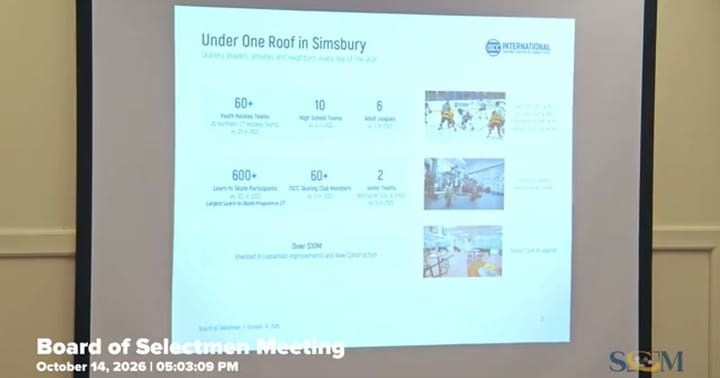
Substantive content: Westhaver said the facility has grown from 20 youth hockey teams to more than 60, from two high school teams to 10, and from roughly 40 Learn to Skate participants to more than 600 annually. He said the rink now hosts USA Hockey regional events, the ACHA college club regional championship, and the Connecticut high school championship, and will become the home rink for the University of St. Joseph's new Division III men's and women's hockey programs beginning Oct. 30. He cited a $170,000 fundraising total with the Scott Hamilton CARES Foundation and said the facility's average monthly electric bill is $37,000. Using a tracking tool called Placer AI, the operators said nine of the top 10 destinations patrons visit after leaving the rink are in Simsbury, though no Simsbury hotel ranks in the top 10.
The deliberation: Selectman Diana asked whether growth at the rink was squeezing ice time for the town's own youth hockey program. Westhaver said Simsbury Youth Hockey "skates at Simsbury Farms more than ISCC" and that the high school team now has a locker room at the rink full time.
Procedural steps and outcome: No vote was taken; the item was informational.
Implications and what is next: The rink's expansion continues to factor into town economic-development discussions, including a potential hotel project the operators said they are working through approvals on with the town.
Main Street Partnership office vacancy project
Background and stakes: Simsbury has a growing inventory of vacant office space, a trend Main Street Partnership Executive Director Sarah Nielsen said predates but was worsened by the pandemic shift to remote work. The town-appointed committee, which includes members of the Board of Finance, Board of Selectmen and Zoning Commission, was formed to identify which vacant office parcels merit targeted redevelopment incentives.
The question before the body: Nielsen asked the board for no action but gave an update on the committee's progress and the parcels it has selected for focus.
Substantive content: The committee, acting on a staff recommendation from the planning director, selected 125 and 175 Powder Forest Road and 82 and 86 Hopmeadow Street, and added 10 Mill Pond Lane by unanimous committee vote. Nielsen said 10 Mill Pond Lane carried an appraised value just under $2 million but sold for $675,000, while 82 Hopmeadow Street, appraised above $10 million, sold for $250,000 within the past two months. She said the town applied for a $175,000 Grayfield Revitalization Grant Program planning grant from the state, with Connecticut Main Street Center providing a letter of support; a decision is pending. She said the committee has agreed it does not want additional apartment rentals and is focused on for-sale housing product if any residential conversions occur. Committee member Lalitha Shivaswamy was cited as a resource on high-tech sector recruitment.
The deliberation: No member raised objections; one selectman asked whether the committee was also considering office-to-housing conversions generally, and Nielsen said "nothing's off the table."
Procedural steps and outcome: No vote. Nielsen said the committee's next step is to deliver specific recommendations to the town manager's office, which will present them to the relevant boards and commissions.
Implications and what is next: With a townwide property revaluation less than two years away, Nielsen said declining commercial valuations could shift tax burden onto residential property owners if vacant office space is not returned to productive use.
Public audience
Background and stakes: Fourteen people signed up for public comment, prompting the chair to ask the audience to self-limit speaking time. Comments split chiefly among three threads: a dispute over the September 28 Flock license-plate-reader camera presentation, concerns about the Silverman Group's renewed 689-unit apartment application near the former Hartford Insurance property, and the push to restore library materials funding.
The question before the body: None of the speakers asked for an immediate vote; several asked the board to use its oversight role, given it lacks direct zoning authority, to press town staff for more communication and transparency.
Substantive content: Resident Joan Coe alleged that First Selectman Wendy manipulated the September 28 meeting agenda to prevent public rebuttal of Police Chief Bolton's presentation on the Flock camera system, and alleged the chair altered a public sign-up sheet, which Coe characterized as a potential violation of Connecticut's public-records tampering statute. Coe also alleged Chief Bolton's public remarks about the clarity of license-plate images conflicted with details in a 2025 police report describing a motorcycle operator's clothing and hair. These claims were not addressed on the record by the chair or the chief at this meeting. A separate speaker, identified only as Olivia, voiced support for keeping the camera system, citing the department's 2025 year-end report of 16 burglaries, 108 larcenies and seven motor vehicle thefts.
On the Silverman matter, resident Chris Barnett said the state denied the town's application for a four-year moratorium under Connecticut General Statutes Section 8-30g earlier this year because of incomplete information, and that a corrected application was not expected to be complete until a 20-day public comment period ends around October 19. Barnett noted Silverman submitted a new 689-unit application under the same statute on October 2, which was not made public until October 13. Resident Ellen Gilbert said the new Silverman proposal "looks exactly the same as the old proposal" at 760 pages and 689 units, and asked whether the company intended to bypass the Conservation and Wetlands Agency. Resident Alan Rosenberg asked the board to initiate a comprehensive review of the town's aquifer protection regulations given the property's proximity to the Farmington River, a state-designated Wild and Scenic River.
"Why did it take approximately two months to prepare the corrected moratorium application? Could this process have been expedited?" — Chris Barnett, resident, public comment
On the library, multiple teen speakers, including Bronwyn Wald, Alexis Wong, and two others identified in the meeting only as "Alyssa" or "Cleese," thanked the board for approving a state grant to enclose the library's teen space. Library Board Chair Holly McGrath, library trustee Anne Erickson and resident Lori Boyko offered competing views on whether the $23,000 materials cut should be restored, with Boyko arguing the library's special revenue fund already held a $65,700 surplus.
The deliberation: Town Manager Mark Nelson responded only to the Silverman comments, saying the town "should be very cautious about linking an application for a moratorium... to a specific development," and declined to discuss Silverman further because of pending litigation. No board member responded directly to Coe's allegations regarding the agenda or sign-in sheet.
Procedural steps and outcome: No votes resulted directly from public comment; the library materials request was taken up later as a formal agenda item.
Implications and what is next: The town's corrected 8-30g moratorium application cannot go to the state until after the public comment period closes around October 19, while Silverman's competing application is already filed, leaving the sequencing Barnett and Gilbert flagged unresolved as of the meeting.
First Selectman's and Town Manager's reports
First Selectman Wendy asked for a moment of silence honoring Cheryl Cook, a former selectman who served 2013-2019 and died after a four-year battle with ALS while continuing to serve on the town's DEI commission and aging and disability commission. She said a Flock camera policy follow-up discussion would continue with the town manager and police chief, and that fiscal 2026 closed with a $2 million revenue surplus and $1.25 million expenditure surplus. Town Manager Mark Nelson promoted the Oct. 24 "Sputacular" Halloween event at the Performing Arts Center and thanked the Department of Public Works for a record 975-vehicle turnout at a regional household hazardous waste collection on Town Forest Road. He also announced the Connecticut Conference of Municipalities awarded Simsbury's 2026 Municipal Excellence Award in its population category for the Station Street one-way-to-two-way conversion.
Fiscal year 2026 closeout
Background and stakes: Connecticut towns close their books each fall and the Board of Selectmen must formally act on surplus allocation, fund transfers and capital project reappropriations before the figures roll into the following year's capital reserve calculations.
The question before the body: Finance Director Amy presented the completed fiscal 2026 revenue and expenditure totals and asked the board to act on a series of required transfers and reappropriations.
Substantive content: Total revenue exceeded budget by $2.3 million, driven by $911,000 in back-tax and lien-fee collections, $670,000 in investment income above a budgeted 3.5 percent rate, $504,000 in building permit fees, and $186,000 in town clerk conveyance taxes and recording fees. Expenditures came in $1.2 million under budget, including $351,000 in public safety staffing vacancy savings and $533,000 in health insurance savings, partly offset by a health insurance fund claims overage of $1.4 million against which the town recovered about $1 million through stop-loss coverage. The town's starting fund balance of $20,808,000 grew to $24,403,052 after the $3.5 million surplus; after transfers, the unassigned fund balance landed close to the Board of Finance's 16 percent target.
The deliberation: Selectman Diana asked about the stalled $640,000 Meadowood barn restoration project; Public Works officials said they intend to write to the State Historic Preservation Office acknowledging the town cannot fund full restoration. Selectman Mike asked whether reappropriations reflected inadequate staffing rather than changed policy; staff said a revised Board of Finance interpretation of the capital non-recurring (CNR) policy, not a resource shortfall, now requires facilities and equipment projects to spend down within one year rather than three.
Procedural steps and outcome: The board voted unanimously to reappropriate the listed CNR projects effective October 14, 2026, and separately voted unanimously to approve the capital transfers and project closeouts, which moved roughly $2.4 million into the Capital Reserve Fund, leaving an unassigned capital reserve balance of about $5.46 million heading into the fiscal 2028 budget process.
Implications and what is next: The $5.46 million reserve balance becomes the pool from which the board will fund further capital requests, including any additional Apple Barn costs expected in the fiscal 2028 budget.
Year-end surplus allocation requests
Background and stakes: Town Manager Mark Nelson said the town has historically used year-end surplus for capital expenses, anticipated cost pressures, or deferred priorities unlikely to clear a normal budget cycle. Nine specific requests were brought forward.
The question before the body: Whether to approve each of nine discrete surplus-funded requests.
Substantive content and deliberation, item by item
Library materials ($23,000): Library officials and a Strategic Planning Committee survey cited roughly 80 percent of respondents wanting more materials, and a 6 percent drop in circulation this year. First Selectman Wendy noted the library's zero-based budget review had found "there wasn't a lot of low-hanging fruit" elsewhere. Selectman Steve supported the request, saying "I feel like it's kind of a legitimate spend of the $23,000." The board approved unanimously, with Wendy stressing the restoration was one-time.
Ambulance deficit ($86,000, discussed as $85,000 in the association's letter): Simsbury Volunteer Ambulance Association representative Chris Kelly said transports fell 2.9 percent against a 4 percent increase assumed in the town's memorandum of understanding, while EMS wage inflation in Connecticut ran 6 percent versus a budgeted 3 percent. He said the association's reserves had fallen to about $36,000. Selectman Mike asked whether any of the funding would cover staff bonuses; Kelly said the association's only bonus is tied strictly to a director's debt-collection performance, which he said outperforms third-party collectors. The town plans an external audit of the association's finances before negotiating the next multi-year memorandum. The board approved the transfer unanimously.
Apple Barn design and site work ($600,000): Covered above; approved 4-1 with Selectman Mike dissenting, consistent with his stated position at the prior meeting that he did not support funding above the $300,000 legislative grant already secured.
Fuel reserve ($300,000): DPW's Tom Roy said fuel futures the town locked in were upended by geopolitical events, including the Iran strike and discussion of a Venezuela-linked market shift, and that diesel costs could run 20 percent above or below budget depending on market movement. The board approved $300,000 as a contingency, 5-0, with any unspent balance returning to the general fund.
Town Hall entrance upgrade ($85,000): Facilities staff, through Tom Taberski, proposed a glass storefront enclosure for the main entrance to address water intrusion and improve rain-day accessibility to the building's ramp. First Selectman Wendy and one other member voted no, with Wendy saying "I feel like this seems premature to find without even knowing what it really looks like." The item passed 3-2.
Ballistic vests and helmets ($72,915): Police officials, including a department representative identified only as Chris, said the department's ballistic plates reach the end of a roughly 10-year warranty next year and would be replaced with thinner, lighter plates that fit directly into officers' existing external carrier vests rather than requiring a separate overlay vest during active incidents. Twenty-two ballistic helmets, assigned to patrol cars rather than individual officers, are already past their five-year warranty. The board, at Selectman Steve's suggestion, directed the purchase be timed for delivery near the new fiscal year rather than immediately. Approved unanimously.
Roofing assessment ($65,000): Facilities staff proposed hiring a roofing consultant to refine a newly completed 20-year, now effectively 21-year, facilities capital plan, after finding some roofs are deteriorating faster than their rated lifespan due to ventilation issues. Selectman Diana and First Selectman Wendy pressed staff on whether Board of Education roofs, separately maintained, should be folded into the same assessment; staff agreed to invite the district to participate but recommended the town proceed on its own buildings now. Approved unanimously.
Gateway signs ($40,000): Public Works proposed adding brownstone-pillar-style gateway signs at entry points lacking any marker, including Tariffville, Wolcott Road and Route 9, after the town's older wooden welcome signs were removed years ago and never replaced. Selectman Steve argued the signs should affirmatively say "Welcome to Simsbury" rather than simply name the town. The board approved 4-1, directing staff to return with a specific design memo.
Town Hall office realignment and dais resurfacing ($35,000): Facilities staff proposed relocating IT and HR staff who currently sit at opposite ends of the building, and selectmen asked that the same funding address long-standing complaints that board members cannot see each other across the flat dais. The board increased the original $25,000 ask to $35,000 to include a curved topper surface and video screens. Approved unanimously.
Implications and what is next: Combined, the nine requests draw roughly $1.6 million from the $3.5 million fiscal 2026 surplus, leaving the remainder to replenish the Capital Reserve Fund ahead of the fiscal 2028 budget cycle, when the Apple Barn, ambulance memorandum renewal and health insurance cost trends are expected to resurface.
Board of Assessment Appeals policy resolution
Background and stakes: State law allows local Boards of Assessment Appeals to decline to hear complex commercial and industrial tax appeals above $1 million, sending those cases directly to Superior Court. The town has fielded more than 230 tax appeals in the last revaluation cycle and expects more with a revaluation due within two years.
The question before the body: Whether to adopt a resolution recommending, but not requiring, that Simsbury's Board of Assessment Appeals hear complex commercial and industrial appeals above $1 million rather than automatically referring them to court.
Substantive content: Town Manager Mark Nelson said the assessment appeals board chair confirmed the board does sometimes hear appeals above $1 million already, contrary to some assumptions, but wanted the recommendation's advisory nature on record. Selectman Steve argued that defaulting to Superior Court forces commercial taxpayers into costly legal representation and denies them a chance to be heard, calling the practice inequitable.
"You are telling the commercial landowners they must spend money on legal representation... that's costing us money." — Selectman Steve
The deliberation: A member asked whether a dollar cap should be raised to $2 million instead of amended case-by-case; Nelson said that decision should remain with the assessment appeals board. An amendment was added specifying the resolution applies to "commercial" (and industrial) property, excluding residential appeals, which the board must hear under the statute.
Procedural steps and outcome: The amended motion, citing Connecticut General Statutes Section 12-111, passed unanimously.
Implications and what is next: The recommendation is advisory only; the volunteer Board of Assessment Appeals will decide whether to change its practice, with the selectmen offering potential funding support, drawn from the revaluation budget line, for additional analysis on complex cases.
Closing items
The board approved its own minutes and briefly discussed a staff memo on Mountain Farms and County Road neighborhood trail maintenance, with First Selectman Wendy and Selectman Steve noting the memo appeared to request more funding than the board authorized during the budget process, which specified a lower-cost gravel surface rather than paving. The board then voted to enter executive session under Connecticut General Statutes Section 1-200(6)(A) to discuss personnel matters with Town Attorney DiCrescenzo.
WHO WAS THERE
First Selectman Wendy, presiding (surname not confirmed in transcript). Selectman Mike, present, voted against the Apple Barn and gateway sign allocations. Selectman Diana, present, delivered Board of Education, library and youth services liaison reports. Deputy First Selectman Steve, present (referred to in public comment as "Steve Antonio"; surname not independently confirmed). Selectman Sina, present, reported on Zoning Commission and Police Commission items. Selectman Kevin, absent, described as traveling. Town Manager Mark Nelson, staff. Finance Director Amy, staff (surname not given in transcript). Department of Public Works staff Tom Roy, staff. Facilities/Parks staff Tom Taberski, staff (role inferred from context; spelling unconfirmed). Police Chief Bolton (transcript alternately renders the name "Bolter"), staff. A police department representative identified only as "Chris," staff (distinct from ambulance association's Chris Kelly). Town Attorney DiCrescenzo, staff, present for executive session. Simsbury Volunteer Ambulance Association representative Chris Kelly, outside party, presented on ambulance funding deficit. ISCC presenters Adam Westhaver and "Kelly" (surname not given), outside parties. Main Street Partnership Executive Director Sarah Nielsen, outside party, presented office vacancy project update. Public commenters: Joan Coe, Dan Summer (also rendered "Dan Sommer"), Chris Barnett, Bronwyn Wald, Alexis Wong, two additional teen speakers identified inconsistently as "Alyssa"/"Cleese" and one unnamed, a commenter identified only as "Olivia," Ellen Gilbert, John Hurley, Holly McGrath (Library Board Chair), Anne Erickson (library trustee, Friends of the Public Library board member, Strategic Planning Committee member), Alan Rosenberg, and Lori Boyko.
ORGANIZATIONS AND DOCUMENTS REFERENCED
Silverman Group — developer behind a renewed 689-unit affordable-housing application under CGS 8-30g for the former Hartford Insurance property, discussed extensively in public comment. Simsbury Volunteer Ambulance Association (referenced in transcript by variant acronyms "SPAA"/"SCAA") — subject of the $86,000 deficit transfer and a planned town-ordered audit. International Skating Center of Connecticut (ISCC) — rink on town-owned land, subject of the growth presentation. Simsbury Main Street Partnership — nonprofit leading the office-vacancy redevelopment committee. Connecticut Main Street Center — state partner organization that helped the town apply for a Grayfield Revitalization Grant. State Historic Preservation Office (SHPO) — cited regarding the stalled Meadowood barn restoration project. Board of Finance — sets the town's fund balance policy (15.5-16.5 percent) and bonding guidance ($5 million per year, $10 million per two years), cited throughout the capital discussion. Board of Assessment Appeals — subject of the advisory resolution on hearing commercial tax appeals over $1 million. Connecticut General Statutes Section 8-30g — cited by resident Chris Barnett regarding the town's affordable-housing moratorium application. Connecticut General Statutes Section 12-111 — cited in the Board of Assessment Appeals resolution. Connecticut General Statutes Section 1-200(6)(A) — cited as authority for entering executive session. Connecticut Conference of Municipalities — awarded the town's 2026 Municipal Excellence Award for the Station Street conversion project.
Share this story
Know someone in Simsbury who follows town government? Share Townbrief Simsbury: they can sign up free.